


FlexStation 3 Multi-Mode Microplate Reader
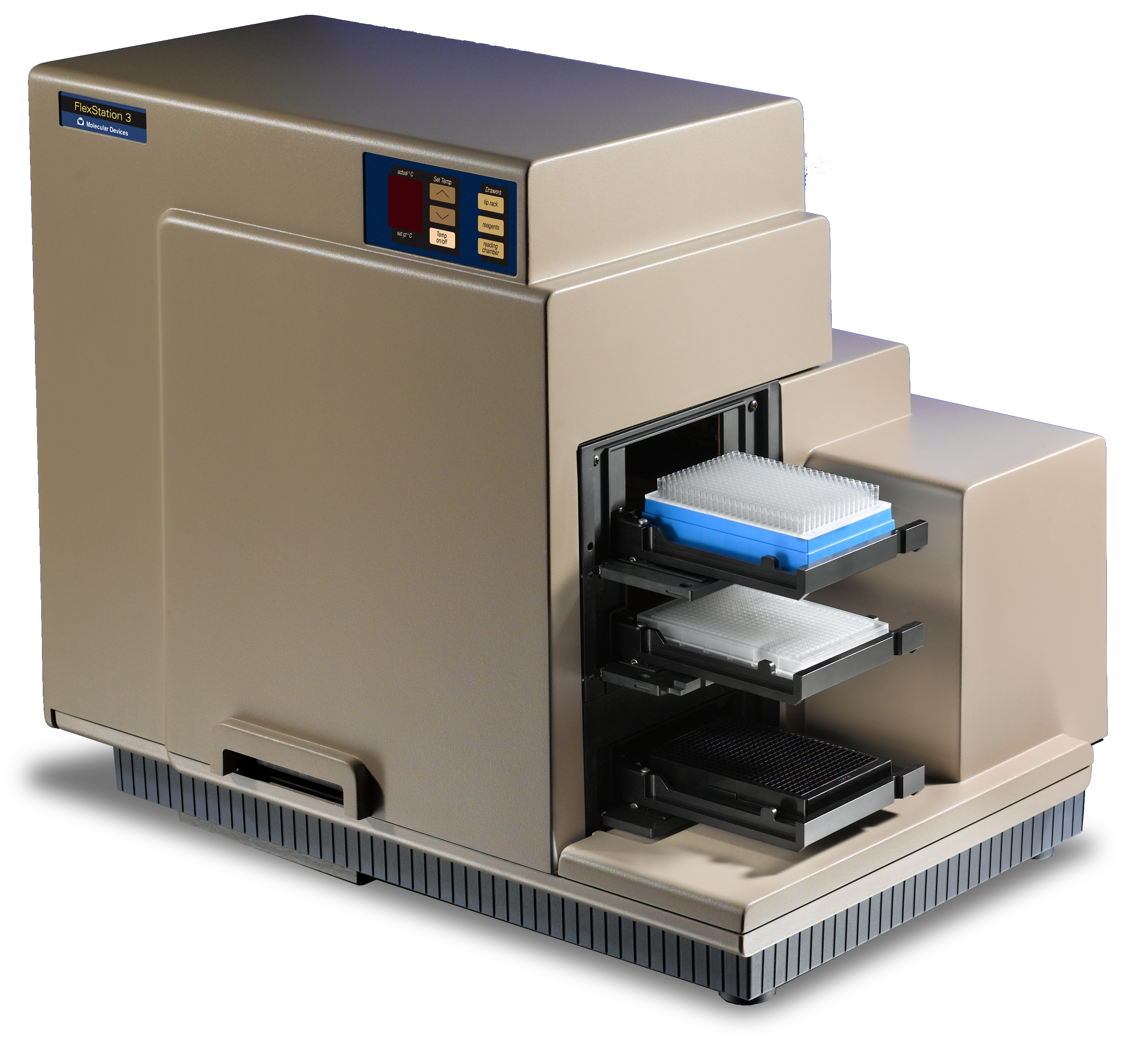
Five-mode reader with wide range of applications
- The FlexStation® 3 reader’s optics are designed to easily adapt to changes in assay requirements while maintaining the optimal performance of a single-mode reader. Based on the SpectraMax M5e platform, this five-mode reader addresses multiple application technologies including: absorbance, fluorescence intensity, fluorescence polarization, luminescence and time-resolved fluorescence. Dual monochromators allow users to target the optimal assay excitation and emission wavelengths and eliminate the need to change expensive band pass filters between experiments.
Flexible liquid transfer enables more assay conditions
- Using an 8- or 16-channel pipettor, the FlexStation 3 reader offers added assay flexibility over dispenser-based systems by transferring reagents from 96 or 384 distinct wells in asource plate to a read plate, simultaneously. In addition, users can define individual reagents and concentrations to be delivered to each well.
Comprehensive Reader Validation
- SpectraTest® Absorbance and SpectraTest Fluorescence Validation Packages are available to determine the optical characteristics of the system. The FlexStation 3 Reader exclusively offers fluid transfer validation using Molecular Devices patented PathCheck® Feature to quantify the integrated 8- and 16-channel pipettor head performance. These tools can be used in conjunction with SoftMax® Pro Software.
Automating with Ease
- The FlexStation 3 reader can be integrated with a variety of automation solutions. Our Automation Vendor Partners Program has streamlined the integration of our microplate reader systems with all leading partner robots. The “out-of-the-box” automation solution saves up-front integration time and resources.
Assay Kits
- We offer a full line of assay kits optimized for use with the FlexStation 3 reader.
The FlexStation 3 Microplate Reader is supplied with SoftMax® Pro Microplate Data Acquisition & Analysis Software, Molecular Devices' industry leading all-in-one data acquisition and analysis software. Among the various ready-to-read protocols, users will find pre-written SpectraDrop™ Micro-Volume protocols enabling micro volume applications measurement.
SoftMax Pro Software offers:
- The most extensive library of supported application protocols to get you started faster
- Optional tools for regulated labs with SoftMax Pro GxP Software to speed compliance
- Advanced calculations including non-linear fitting metrics for in-depth analysis
- The only Mac and Windows native application support for seamless exchange of data files between operating systems
- Proven integrations with leading automation and LIMS platforms for partnered solutions
Compliance: Softmax Pro Software also enables the user to validate the integrated 8- and 16-channel pipettor head performance. The FlexStation 3 Microplate Reader offers this fluid transfer validation using the patented PathCheck® Pathlength Correction technology. These tools can be used in conjunction with SoftMax Pro Validation Package and IQ/OQ/PQ Validation protocols for FDA 21 CFR Part 11 compliance.
|
Technical Specifications |
|
| Plate formats | 6, 12, 24, 48, 96, 384 wells |
|
Light source
|
Xenon Flash Lamp
(1 joule/flash) |
|
Detectors
|
2 photomultiplier tubes
|
|
Shaker time
|
0 to 999 seconds
|
|
Temp. control*
|
2°C above ambient to 45°C
|
|
Flex reading
|
Abs + fluidics
FI + fluidics Lum + fluidics |
|
Endpoint reading
|
All modes + fluidics
|
|
Kinetic reading
|
All modes + fluidics
|
|
Spectral scanning
|
All modes
|
|
Well scanning
|
Abs, FI, TRF, Lum
|
|
* Temperature is regulated in the Read Chamber.
|
|
|
Fluidics (96- & 384-Well Plates Only)
8-channel
|
|
|
Max. volume
|
200 μL
|
|
Precision @ 50 μL
|
2% CV
|
|
Precision @ 5 μL
|
8% CV
|
|
Dispense max. rate
|
208 μL/sec.
|
|
16-channel
|
|
|
Max. volume
|
30 μL
|
|
Precision @ 10 μL
|
3% CV
|
|
Precision @ 1 μL
|
5% CV
|
|
Dispense max. rate
|
52 μL/sec.
|
|
Absorbance Photometric Performance
|
|
|
Wavelength range
|
200–1000 nm
|
|
Wavelength selection
|
Monochromator, tunable
in 1.0 nm increments |
|
Wavelength bandwidth
|
≤4.0 nm
|
|
Wavelength accuracy
|
±2.0 nm
|
|
Wavelength repeatability
|
±0.2 nm
|
|
Photometric range
|
0–4.0 OD
|
|
Photometric resolution
|
0.001 OD
|
|
Photometric accuracy
|
< ±0.006 OD ±1.0%,
0–2 OD |
|
Photometric precision
|
< ±0.003 OD ±1.0%,
0–2 OD |
|
Stray light
|
< 0.05% @ 230 nm
|
|
Fluorescence Intensity Performance
|
|
|
Reading capabilities
|
Top- or bottom-read
|
|
Wavelength range
|
250–850 nm
|
|
Wavelength selection
|
Monochromators, tunable
in 1.0 nm increments |
|
Bandwidth (EX, EM)
|
9 nm, 15 nm
|
|
Sensitivity**
|
≤ 1 pM fluorescein in 96 wells
< 1.5 pM in 384 wells |
|
Fluorescence Polarization Performance
|
|
|
Reading capabilities
|
Top-read
|
|
Wavelength range
|
400–750 nm
|
|
Wavelength selection
|
Monochromators, tunable
in 1.0 nm increments |
|
Bandwidth (EX, EM)
|
9 nm, 15 nm
|
|
Precision**
|
≤ 3.5 mP standard deviation
at 1 nM fluorescein in 96 wells |
|
Time-Resolved Fluorescence Performance
|
|
|
Reading capabilities
|
Top- or bottom-read
|
|
Wavelength range
|
Wavelength range:
|
|
Wavelength selection
|
Monochromators, tunable
in 1.0 nm increments |
|
Bandwidth (EX, EM)
|
9 nm, 15 nm
|
|
Precision data collection
|
1–100 flashes, delay of
0–600 μsec. before read, integration time-selectable between 50–1500 μsec. |
|
Sensitivity**
|
≤ 10 fM europium in 96 wells
|
|
Luminescence Performance
|
|
|
Reading capabilities
|
Top- or bottom-read
|
|
Wavelength selection
|
All wavelengths or with
selected wavelengths |
|
Wavelength range
|
250–850 nm
|
|
Sensitivity**
|
≤ 43 pM ATP in 96 wells
≤ 75 pM ATP in 96 wells |
|
Cross-talk
|
< 0.3% in white 96- and
384-well microplates |
|
Standard Read Times (minutes:seconds)*
|
|
|
|
96-wells | 384-wells
|
|
Absorbance
|
0:18 | 0:49
|
|
Fluorescence Intensity
|
0:17 | 0:48
|
|
Fluorescence Polarization
|
0:42 | 2:03
|
|
Time-Resolved Fluorescence
|
0:17 | 0:48
|
|
Luminescence
|
2:00 | 7"00
|
|
* With 3 flashes/well in absorbance and fluorescence modes, and 1 sec./well integration in luminescence.
|
|
|
General Specifications |
|
|
Dimensions (in.)
|
23 (W) x 19 (H) x 16 (D)
|
|
Dimensions (cm)
|
58 (W) x 49 (H) x 40 (D)
|
|
Weight
|
50 lbs. (22.7 kg)
|
|
Power consumption
|
500 VA
|
|
Power source
|
90–240 Vac, 50–60 Hz
|
The FlexStation 3 Microplate reader supports a wide variety of assay categories including:
- Fast kinetic calcium mobilization assays
- Membrane potential assays
- ELISAs
- DNA/RNA quantitation
- Protein assays
- Enzyme kinetics
- Protease assays
- Fluorescent proteins and FRET
- Cell viability and cytotoxicity assays
- Reporter gene assays
- Cell migration assays
- Cell adhesion assays
- Fatty acid uptake assay
- Neurotransmitter transporter uptake assays
- ADME-Tox
- Membrane permeability
- Phosphotase/kinase assays
- Microbial growth assays
- Endotoxin assays
-
Low volume applications
|
Product |
Part Number |
| FlexStation 3 Microplate Reader with SoftMax Pro Software Includes: FlexStation 3 Base System, 1 year warranty covering parts & labor. **Does not include 8 or 16 channel pipettor head, must be purchased separately and MUST be ordered at the time of ordering the instrument. |
Flex3 |
| SpectraDrop™ Micro-Volume Starter Kit | 0200-6262 |
| SpectraDrop™ Micro-Volume HTS Kit | 0200-6267 |
| FlexStation 3 Benchtop Multi-Mode Microplate Reader IQ/OQ Validation Protocols |
0112-0160 |
Related Video
Related Collateral
Applications
- Characterization of hERG channel blockers using the FLIPR Potassium Assay Kit on the FlexStation 3 Reader
- IMAP Phosphodiesterase Assays on SpectraMax Multi-Mode Microplate Readers
- Stem Cell-Derived Human Neurons in CNS Drug Discovery
- Monitoring Receptor Mediated Changes in [CA2+]i using Single-and Dual-Wavelength Indicators on the FlexStation Benchtop Multi-Mode Microplate Reader
- Gq-coupled Receptor Assays Using the FlexStation System: M1 Muscarinic Receptor
- Comparison of Photina Luminescent Calcuim Mobilization Assays n both the FlexStation 3 and FLIPR Tetra Systems
- Optimization of a Muscarinic M3-receptor Assay using Frozen "Assay Ready" CHO Cells on the FlexStation 3 System: The Impact of Calcium Dye Selection and Cell Culture Conditions
-
ß-Lactamase-Inhibitor Protein Binding Affinities: Detection of Hydrolysis of ß-Lactam Substrate by TEM-1 Enzyme and Inhibitor Binding Using The FlexStation 3 Microplate Reader
Posters
- Dual Luciferase® Reporter Assay Detection on Next-Generation FlexStation 3 Microplate Reader with Integrated Fluidics
- Measurement of Proteosome Inhibition in Live Cells on the Analyst® GT, FLEXstation and
Gemini EM Microplate Readers Using the BD Biosciences Proteasome Sensor
Related eBooks
- Advance Detection of Cytotoxicity: A wide range of solutions for predicting cytotoxicity earlier in your drug discovery process
Number of Citations*: 3,260
Latest Citations:
For a complete list, please click here.