


DispenCell Single-Cell Dispenser
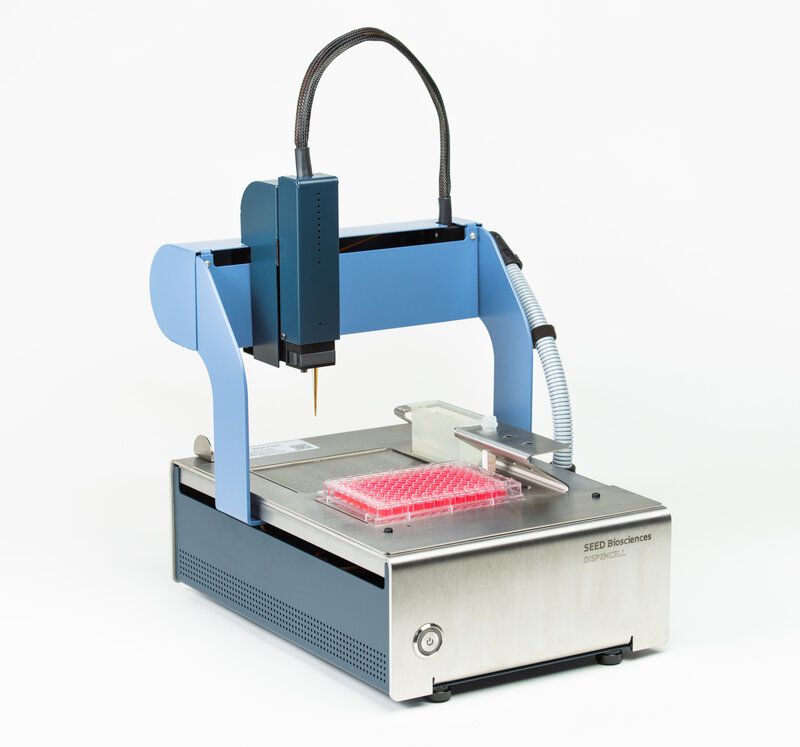
DispenCell integrates seamlessly into your laboratory workflow, with a plug-and-play approach. Flexible and effortless, DispenCell operates equally under sterile conditions in a culture hood, or on a simple benchtop.
Compact, automated cell dispenser for fast, easy and gentle single-cell isolation
The DispenCell™ Single-Cell Dispenser is an automated laboratory instrument designed for fast, easy and gentle single-cell isolation.
Immediate and traceable proof of clonality
DispenSoft, the single-cell analysis software included with DispenCell, provides immediate and traceable proof of clonality. The instrument is fitted with a sensing tip that detects the passage of cells, allowing users to check for proof of clonality immediately after the cells are dispensed. All dispensing data is automatically stored, allowing for easy generation of a clonality report.
As gentle as manual pipetting
DispenCell has unique technology which allows for extremely gentle handling of the cell sample. Cells are exposed to no more pressure than with manual pipetting (less than 0.1 psi). This allows the instrument to preserve cell viability and outgrowth while simultaneously increasing cell deposition efficiency.
Compact
The small footprint of the DispenCell allows it to fit perfectly into any laboratory setting: under a hood to work under sterile conditions, on a bench top for routine seeding, or in a pre-existing automated workflow.
Introducing DispenCell Single-Cell Dispenser
Features
Proof of clonality
A single-cell analysis software tool provides a traceable proof of clonality report instantly.
Contamination-free
A patented disposable tip ensures clean isolation of single cells and no cross contamination. Certified free from animal products and cytotoxic material.
High cloning efficiency
Unique design ensures gentle dispensing for better viability and cloning efficiency
Easy to use
Easy to set up, and intuitive with a simple interface. No cleaning or calibration required.
Verify monoclonality confidently at day zero with a CloneSelect Imager FL and DispenCell bundle


Streamline your workflow when you pair the DispenCell with the CloneSelect Imager FL
The all-new CloneSelect Imager FL adds high contrast multichannel fluorescent technology in addition to the standard white light imaging that allows for accurate single-cell detection and proof of monoclonality at day 0. Identify and verify gene edits with comparative confluence assays.
- Document evidence of single cells and confluency digitally for auditing and submission to regulatory authorities
- Image cells non invasively at multiple time points to monitor colony formation
- Screen using high resolution white light imaging
- Deliver real-time results with on-the-fly analysis
- Automation and integration ready
Specifications & Options of DispenCell Single-Cell Dispenser
General specifications
Power Supply
External, PSGE120-12-01, 12v, 10A, 120W
Plate holder
2 plates (96 or 384 wells)
Minimal cell number
100 cells
Calibration
Not required
Cleaning
Not required
Sample prep
10 min
Dispensing
96 well plate in 5 min
Cell parameters
Size, doublets
Input voltage (External power supply)
100 - 240 V~, 50 - 60 Hz
Input current (External power supply)
max 2.0 A
Input voltage (Instrument)
12.0 V
Max. power (Instrument)
36 w
Well plates compatibility
96 WP, 200µL, (655101, Greiner)
384 WP, 50µL, (781101, Greiner)
384 WP low volume, 10µL, (788096, Greiner)
Loading volume
per 30s load. time @2x10^4 cells/mL : 10µL, 200 cells
Particle range detection capability
Dielectric, from 8µm to 25µm
Time to dispense a 96 well plate
<= 10 min (provided Tcc < 4s)
<= 13 min (provided Tcc < 6s)
Time to dispense a 384 well plate
<= 40 min (provided Tcc < 4s)
<= 52 min (provided Tcc < 6s)
Monoclonality reliability*
>=90%
Missed/Corrupted data points
< 1% per plate (only accounted for point serie n>6)
Compressed Air Specifications
Minimum operating pressure
Less than 0.1 psi
Instrumentation
Instrument weight
11.1 kg
Instrument Size
328 x 271.5 x 369 mm3
** Monoclonal reliability error definition:
Impedance trace reliability error = P(obs > 1|z = 1) = P(obs > 1nz = 1)/P(z = 1)
The monoclonal reliability error is defined as the probability of observing more than one particle/cell when the impedance time trace exhibits one event. The monoclonal reliability is defined as the ones' complement of its error.
Applications of DispenCell Single-Cell Dispenser
-
Cell Line Development
-
Monoclonal Antibodies (mAbs)
-
Monoclonality
-
Single-Cell Genomics
-
Single-Cell Sorting
-
Cell Line Development

Cell line development is a critical step in the process of generating biopharmaceutical molecules, such as monoclonal antibodies. The process often begins with transfecting the host cell type with the DNA encoding the therapeutic protein of interest allowing for random or directed integration of target DNA into the host cell genome. Thousands of clones are screened to isolate the rare high producing cells, a manual and time-consuming process.
Monoclonal Antibodies (mAbs)

Monoclonal antibodies (mAbs) originate from one unique parent cell, thus binding only to a single epitope. Monoclonal antibody discovery typically refers to the screening and identification of specific antibodies that target a specific epitope for the diagnosis and treatment of diseases, like the coronavirus for COVID-19.
-
Monoclonality

Cell line development and assurance of monoclonality are critical steps in the process of generating biopharmaceutical molecules, such as monoclonal antibodies. A cell line can be established following the isolation of a single viable cell robustly expressing the protein of interest. A key milestone in this process is documenting evidence of clonality. Documentation of clonality is typically image-based, whereby an image of a single cell is produced and included in regulatory filings.
Single-Cell Genomics

The isolation of single cells remains a challenging task in single-cell genomics. Current methods lack the evidence that only a single-cell has been isolated in the analysis vessel. It is important that the integrity of the cells is maintained prior to their lysis in order to preserve their DNA.
Furthermore, cells should undergo as little stress as possible prior to their lysis in order to preserve their RNA and its expression level. The CloneSelect Single-Cell Printer Series deposits single cells in a very gentle manner, guaranteeing high purity and high viability.
This provides optimal basis for downstream single-cell genomic analysis.
-
Single-Cell Sorting

Cell line development requires the discovery of single cell-derived clones that produce high and consistent levels of the target therapeutic protein. The first step in the process is the isolation of single, viable cells. Limiting dilution is a technique that relies on statistical probability but is time consuming. The DispenCell™ Single-Cell Dispenser enables fast, easy, and gentle isolation of cells, as well as provides instantaneous proof of clonality and traceability post-cell dispensing.