

MultiClamp 700B Amplifier, Patch Clamp, Elektrofiziológia
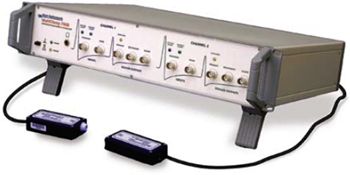
A microelectrode amplifier that combines leading edge electronics design and a wealth of features and functions with an intuitive user interface that simplifies the creation of complex protocols.
- Support of up to four headstages makes the MultiClamp 700B System four amplifiers in one.
- Software control of all amplifier settings for automated optimization features, reduction of manipulation steps, and convenient, reliable telegraphing.
- Quick Select Feature recalls up to three saved amplifier configurations for fast, reproducible application switching.
- Optional SoftPanel allows amplifier control using knobs and buttons for a more conventional feel to amplifier control.
- Integrated seal test in voltage- and current-clamp mode for easy monitoring of membrane and cell health parameters.
- Dual Command Potentials add flexibility by processing input signals from two different sources.
- Selectable command sensitivity for flexible control of the output waveform.
- Pipette offset compensation with auto-mode quickly removes signal offsets.
- Automatic pipette capacitance compensation requires only the push of a button to neutralize the contribution of the glass pipette and the pipette holder to the capacitance of the circuitry.
- Series resistance compensation: Prediction helps achieve the desired command level faster by transiently supercharging the membrane potential.
- Series resistance compensation: Correction improves the bandwidth of the recording by eliminating the error introduced by the voltage drop across the series resistance.
- Automatic cell capacitance compensation corrects for the capacitance of the cell membrane in whole-cell recordings with a single mouse click.
- Automatic mode switching enables you to control the transition between voltage and current clamp by an external trigger or depending on the recorded signal.
- Automatic oscillation detection prevents damage to a cell when electrical feedback occurs.
- Leak subtraction for automatic correction of leak currents with a smart, software-based algorithm.
- Selectable output gain with 11 settings to scale the output signal to the desired level.
- Audio monitor for acoustic tracking of the signal while you are busy looking down a microscope.
- Fine-tunable 4-pole bessel and butterworth low-pass filters act as anti-aliasing filters and can be used to pre-condition the output signal.
| General Specifications | |
| Dimensions (in.) | 3.5 (H)x 19 (W) x 12 (D) |
| Dimensions (cm) | 8.9 H) x 48.3 (W) x 30.5 (D) |
| Weight | 10 lbs. (4.54 kg) |
| Headstage (in.) | 0.875 (H) x 1.625(W) x 2.3125 (D) |
| Headstage (cm) | 2.0 (H) x 4.0 (W) x 8.4 (D) |
| Channels | 2 (sharing a common ground) |
| Communications | USB 1 Type B female ports |
| Rack use | Standard 19" rack-mount (2U) with handles |
| Benchtop use | Bayonet feet |
| Power |
85-260 VAC
50-60 Hz, 30 W (max)
|
| Safety | CE marking (Conformité Européenne) |
Basic Ion Channel Research
Ion channels are pore proteins that are involved in a large variety of physiological processes. Basic research in the ion channel field furthers the understanding of ion channel function as well as their roles within cellular pathways and processes. Single-channel research helps with elucidating the mechanisms underlying ion channel function on a single-molecule level. Whole-cell and perforated patch clamp recordings are typically used to investigate the action of modulators on entire populations of ion channels in the membrane of a cell.
Cell Pathway Analysis
Ion channels are involved in many cell pathways and understanding the function of ion channels in response to changes in membrane potential or the presence or absence of other molecules is important in order to understand exactly how ion channels participate in normal and abnormal biological processes such as cell differentiation and migration, disease states, neuronal communications, etc.
Disease Research
Ion channels play a role in many diseases, including hypertension, cardiac arrhythmias, gastrointestinal, immune and neuromuscular disorders, pathological pain and cancer. By understanding the exact role that ion channels play in a particular disease, researchers might be able to find a way to affect the ion channel in such a way as to alter the course of the disease.
Safety Assessment
A critical part of drug discovery involves safety assessments, such as hERG testing, in order to eliminate any compounds with potential safety concerns. Conventional patch clamp has played an important role in collecting evidence for the absence of side effects before submission of a drug candidate to regulatory authorities. Even if automated electrophysiology has shifted safety testing to earlier stages in the drug discovery process, follow-up with conventional patch clamp is an essential step in the workflow.
- HS-2-x0.0001MU
- HS-2-x0.01MU
- HS-2A-x0.1LU
- HS-2A-x1LU
- HS-2A-x1MGU
- HS-2A-x10MGU
- HS-2A-x100MGU
- VG-2A-x100 (virtual ground)
- CV-7B/BL for lipid bilayer recordings
- CV-7B/EC for electrochemistry recordings (amperometry, voltammetry)
| DESCRIPTION | DETAILS | PART NUMBER |
|---|---|---|
| MultiClamp 700B Headstage CV-7B | Patch-clamp headstage | 1-CV-7B |
| MultiClamp 700B Headstage CV-7B/BL | Bilayer headstage | 1-CV-7B/BL |
| MultiClamp 700B Headstage CV-7B/EC | Electrochemistry headstage | 1-CV-7B/EC |
MultiClamp Commander
Instead of the traditional front panel knobs and switches, the MultiClamp 700B Amplifier is controlled by the MultiClamp 700B Commander, a software program that runs on a host computer (PC and Macintosh; see System Requirements) and communicates with the amplifier via a USB interface. This control interface reports resistance, voltage, and current measurements and provides automation of Bridge Balance, Pipette Offset, and Pipette Capacitance Neutralization for improved ease of use. Amplifier settings such as gain, filter frequency, whole-cell capacitance, recording mode, and input/output scale factors are automatically telegraphed to the data acquisition software via "messaging" through the computer operating system. Quick Select provides easy access to stored preset configurations that apply to particular applications.
In addition, MultiClamp Commander has "smart" features that protect cells from potentially damaging signal oscillations and automatic mode changes based on internal signal thresholds or externally applied signals. Amplifier settings such as gain, filter frequency, recording mode, and input/output scale factors are automatically telegraphed to thepCLAMP 10 Data Acquisition Software via the USB connection. This ensures that the amplifier settings are accurately and conveniently stored in the recorded data files.
To obtain the installer for a more in-depth look at MultiClamp 700B Commander Software, please go to our Customer Support page.
In combination with a Digidata® 1550 Data Acquisition System and pCLAMP™ Software, the MultiClamp 700B Amplifier forms the core of a setup like those used in many electrophysiology labs around the world. Computer control of the amplifier ensures correct scaling and logging of experimental parameters. The Clampex Data Acquisition Module, which is part of the pCLAMP Software, makes optimal use of the features of the MultiClamp 700B Amplifier.
Developer Support
The MultiClamp Software Development Kit provides the tools for programmers who wish to develop software that is capable of collecting information about the state of the MultiClamp 700B or 700A Amplifier (i.e., telegraph settings). This will be useful for Microsoft Windows software development, since the applications will communicate via a registered messaging interface.
The latest version of MultiClamp 700 Commander automatically installs the files required for 3rd party support. Browse the "moleculardevicesmulticlamp-commander" directory to locate the files.
Note: Although we are committed to the integrity of this SDK, Molecular Devices will not provide direct technical support for writing programs using the SDK.