


GenePix 4300/4400 Microarray Scanner
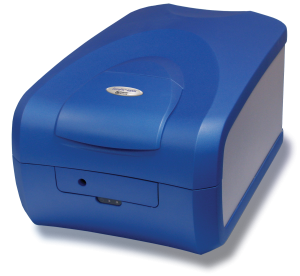
High-resolution for High-density Microarrays:
- Upgrade for the Future: While the GenePix® 4300A Microarray Scanner has a maximum resolution of 5µm per pixel; it can be upgraded to 2.5 micron per pixel resolution at any time. So you have the option to match the scanner resolution as your microarray research requirements advance.
- Full Flexibility in Choosing Dyes: With up to four internal solid-state diode and gas lasers, the scanner is a remarkably compact bench-top unit. The laser flexibility and choice of up to 12 user-accessible emission filters allow you to select your dyes from a broad variety of fluorophores for your assay (CyTM3 and CyTM5 dyes, Fluorescein, GFP, Texas Red, Alexa Fluor® dyes, or quantum dots.
- Trust your Microarray Signals: with outstanding positional performance and uniformity, the GenePix® 4300 and 4400 Microarray Scanners allow you to perform the most demanding application, like latest generation NimbleGen® arrays or array CGH experiments. Specified and tested for a field uniformity of +/- 2%, these scanners resolve a spatial frequency of 200 line pairs per millimeter (LPPM), and feature a contrast ratio (CTF) of least 50% at the highest resolution.
- Less Noise in Your Data: Get unparalleled signal-to-noise (SNR) performance. GenePix® Microarray Scanners uses only the best components, like low-noise digitizer and photomultiplier tube (PMT), highest quality optical filters and sensors to reduce scattered light. Together these improvements reduce the noise to a minimum and increase the sensitivity. Unparalleled sensitivity also enables the use of lower laser power settings, which significantly reduces any perceived degradation of your dyes.
- Less Breakable Components: Your microarray is safe in our scanner. With the newly designed six-point-slide holder, we exclusively rely on high-precision machining to eliminate fallible components as commonly used in dynamic autofocus systems.
- Designed for High Duty-Cycle Usage: Improved high duty-cycle motors ensure maximum translation and focus motor lifetime. The new patent pending voice coil was designed to minimize vibration and optimize heat dissipation.
- The GenePix 4400A Microarray Scanner is capable of scanning at a user-defined optical pixel resolution between 2.5 and 100 micron per pixel - allowing you to scan the highest-density microarrays on the market.
The GenePix® 4300/4400 Microarray Scanner and GenePix® Pro Microarray Analysis Software have been designed to work together as a complete, integrated platform. The seamless communication between scanner and software ensures unmatched efficiency for data acquisition and analysis, as well as for real-time scanner performance monitoring. Optional Acuity® Microarray Informatics Software completes the package, offering database storage, clustering algorithms, advanced statistics and visualizations.
- GenePix® SL50 Automated Slide Loader
- GenePix® Pro 7 Acquisition and Analysis Software
- Standard microscope slides (1" x 3", 25 x 75 mm; 0.9-1.1 mm thick)
|
Maximum scan area
|
22 x 75 mm
|
|
Maximum resolution
|
4300A: 5 µm, 4400A: 2.5 µm
|
|
Scan mode and order
|
Sequential; fully user-configurable scan order
|
|
Excitation
|
Up to 4 lasers (all internal); 488 nm, 53 nm, 635nm
|
|
Laser Settings
|
User selectable, from 5-100% (1% increments)
Emission filters: 16 positio user-accessible filter wheel
|
|
Detector
|
Photomultiplier tube (PMT) automatic and manual gain adjustment settings
|
|
Focus offset
|
Adjustable between -50 to +200 μm (1 μm increments)
|
|
Optics
|
Non-confocal
|
|
Emission filters
|
See Configurations section below
|
|
Scanning method
|
Sequential
|
|
Scan time:
|
4 minutes per channel, 10 μm resolution, full scan area
|
|
Pixel Resolution
|
4300A-Adjustable from 5-100 μm, 4400A-Adjustable from 2.5-100 μm
|
|
Digital Resolution
|
16-bit
|
|
Image Format
|
Single-image or multi-image TIFF
|
|
Dynamic Range
|
Four orders of magnitude at SNR > 3
|
|
Rotational Uniformity
|
Less than ±4% non-uniformity
|
|
Image Type
|
Single- or multi- image TIFF
|
|
Barcode Reading
|
Integrated hardware barcode reader; all common 1D and 2D barcodes
|
|
General Specifications |
|
|
Dimensions (cm)
|
43 cm (16.9") x 65 cm (25.6") x 34 cm (13.4") (WxDxH)
|
|
Weight
|
45 kg (99 lbs)
|
|
Power Supply
|
85 to 264 VAC (110 to 340 VDC) universal voltage input
|
|
Line Frequency
|
50-60 Hz
|
|
Power
|
150W
|
|
Fuse
|
2.0 A slow. 5 x 20 mm
|
|
Dimensions (in)
|
16.9 (W) x 13.4 (H) x 25.6 (D)
|
|
Computer interface
|
USB 2.0
|
Proteomics
Although the analysis of the full proteome has not yet been achieved, rapid progress is being made with microarrays in the field of proteomics. Proteomes exhibit large and dynamic complexity; the number for distinct proteins in mammals will certainly exceed the number of genes, requiring the right technology to be in place for the analysis. The flexibility of the GenePix system, and especially the high-throughput capabilities of the GenePix® SL50 Automated Slide Loader, provides adequate tools to researchers.
- Protein arrays
- Peptide arrays
- Antibody arrays
- ELISA arrays
- Reverse Phase Arrays
Genomics
Directed at the genome sequence itself, microarrays have been used to identify novel genes, binding sites of transcription factors, changes in DNA copy number, and variations from a baseline sequence, such as in emerging strains of pathogens or complex mutations in disease-causing human genes.
- SNP genotyping arrays
- Arrayed comparative genomic hybridization (aCGH) arrays
Transcriptomics
The use of high-density microarrays has impacted the measurement of transcript levels to study complex diseases. With the latest development of microarray technology, it is now possible to quantify transcript levels globally and to integrate such data with information relating to disease. Microarrays based transcriptomics enables mapping a critical genomic region for a disease using affected and unaffected individuals and then pinpointing the responsible gene by identifying differentially expressed genes in the critical region.
- Gene expression arrays
- RNA interference (RNAi) arrays
- MicroRNA (miRNA) arrays
Epigenomics
The gene carries the basic unit of information, but this information has an impact only once it is properly programmed by the epigenome. The DNA methylation pattern is cell type specific and correlates with chromatin structure. DNA microarrays are being utilized to identify methylation patterns, and the GenePix automation solution allows the researcher to identify these patterns faster.
- DNA methylation arrays
- Chromatin immunoprecipitation (ChIP) arrays
Novel Applications
The creativity and broad applicability of microarray-based research has no limits and is demonstrated by the vast variety of different microarray applications to conduct large-scale quantitative analysis. With the GenePix® Microarray Scanner System you have the most flexible solution and freedom in your research.
- Tissue arrays
- Quantum Dots
- Carbohydrate Arrays
- Chemical Compound Arrays
|
Product |
Part Number |
|
GenePix 4300A Scanner configurable with GenePix Pro, Includes 532nm green laser and 635nm red laser
|
GENEPIX 4300
|
|
GenePix 4400 Scanner configurable with GenePix Pro, Includes 532nm green laser and 635nm red laser
|
GENEPIX 4400
|
| GenePix Pro Software v7 license | 5004757 |
| AcuityMicroarray Informatics Software | ACUITY PTO |