


SpectraMax Plus 384 Microplate Reader
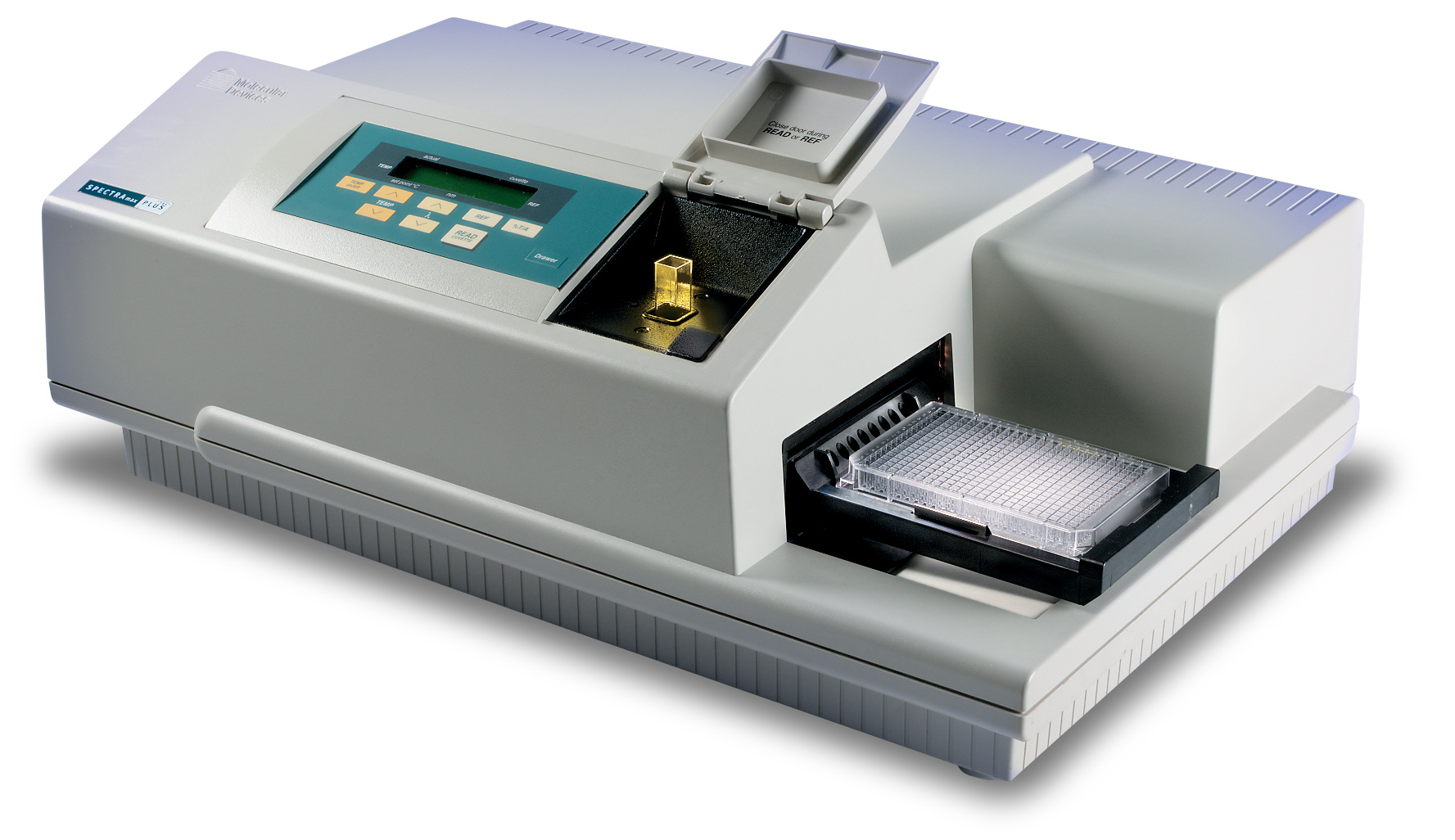
- No filter system: Includes monochromator allowing up to 6 wavelengths at a time in the visible wavelength range and scanning ranges from 190-1000 nm in 1 nm increments
- Easy assay optimization: Read a variety of sample formats from cuvettes to 96- and 384-well microplates in endpoint, kinetic, and spectral scan modes
- Correction for varying microplate well volumes and the elimination of standard curves based on PathCheck® Technology, the only temperature-independent pathlength correction method
- Better experimental signal discrimination using narrow absorbance bandpass for superior peak resolution and increased accuracy.
- Monitoring of temperature-sensitive reactions with consistent temperature regulation from ambient to 45°C
- Thorough mixing of samples in microplate wells with user-programmable Automix feature
- Quickly quantify DNA, RNA, and protein samples as low as 2 µL with the SpectraDrop Micro-Volume Microplate
- Comprehensive data analysis with SoftMax® Pro Software
- Seamless integration with the StakMax® Microplate Handling Stacker
- Comprehensive validation toolset available include:
- SpectraTest® ABS1, FL1, and LM1 Validation Plates for hardware validation of absorbance, fluorescence, and luminescence modes,
- SoftMax Pro Software validation package
- Software tools for FDA 21 CFR Part 11 compliance
| Dimensions (in) | 8.6 H x 22.8 W x 15 D |
| Dimensions (cm) | 22 H x 58 W x 38 D |
| Weight | 30 lbs (13.6 kg) |
| Power Source | 90-250 VAC, 50/60 Hz |
|
Performance Specifications |
|
| Wavelength Range | 190-1000nm |
| Wavelength Selection | Monochromator, tunable 1.0 nm increments |
| Wavelength Bandwidth | ≤ 2.0 nm |
| Wavelength Accuracy | < ± 1.0 nm |
| Wavelength Repeatability | ± 0.2 nm |
| Photometric Range | 0.0 to 4.0 nm |
| Photometric Resolution | 0.001 OD |
| Photometric Accuracy (Microplate) | < ± 0.006 OD ± 1.0%, 0.0 - 2.0 OD |
| Photometric Accuracy (Cuvette) | < ± 0.005 OD ± 1.0%, 0.0 - 2.0 OD |
| Photometric Precision | < ± 0.003 OD ± 1.0%, 0.0 - 2.0 OD |
| Stray Light | < 0.05% @ 230 nm |
| Light Source | Xenon Flash Lamp |
| Microplate Read Time - Endpoint | 96-Well: 9 seconds 384-Well: 29 Seconds |
| Microplate Read Time - Kinetic | 96-Well: 9 second interval 384-Well: 29 second internal |
| Microplate Read Time - Speed Read Mode | 96-Well: 5 seconds 384-Well: 16 seconds |
| Temperature Range | Ambient + 4 °C up to 45 °C |
| Temperature Uniformity (Microplate) | ± 0.5 °C @ 37 °C |
The SpectraMax Plus384 Microplate Reader supports a multitude of absorbance assay categories including:
- Cell viability, proliferation, and cytotoxicity
- ELISAs and immunoassays
- Endotoxin detection
- Enzyme assays
- Micro volume applications
- Microbial growth
- Nucleic acid (DNA) quantitation
- Phosphotases/kinases
- Protein quantitation
- Reporter gene assays
| Product | Part Number |
| SpectraMax Plus 384 Microplate Reader | PLUS 384 |
| SpectraTest ABS1 Absorbance Validation Plate | 0200-6117 |
| StakMax Microplate Handling Stacker | StakMax |
| Quartz 96-well microplate for UV measurements | R8024 |
| Quartz 96-well half-area microplate for UV measurements | R8028 |
| SpectraDrop™ Micro-Volume Microplate Starter Kit | 0200-6262 |
| SpectraDrop™ Micro-Volume Microplate HTS Kit | 0200-6267 |
| Cuvette Validation Set | 0200-2420 |
| Microplate Reader Shelf | 9000-0756 |
SoftMax Pro Software simplifies setting up your assays by providing:
- Simple set-up and automatic instrument recognition
- Pre-defined protocols for endpoint and kinetic ELISA protein plus quantification assays such as Bradford, Lowry, BCA, and DC protein assays
- A wide variety of scan types: Endpoint, Kinetic, Spectrum* and Well Scanning*
- Standard data reduction settings are preselected as default
- Automatic data recovery feature

SoftMax Pro Software offers a variety of customizing options:
- Predefined calculation options for common data analysis functions
- Automatic export to Microsoft Excel
- Instrument settings and plate read area can be adjusted to suit your experiment's needs
- Custom data reduction settings can be selected for optimal signal selection
- Full reports, with font flexibility, and live mini-tables and graphs are now available within the Notes section to simplify the result sharing experience
- Contemporary user community enabling protocol exchange and expertise
sharing among our numerous users

- Proven integration with leading automation and LIMS
SpectraMax Plus 384 brochure
Applications
- Measurement of Residual Sugar in Wine using the SpectraMax Plus 384 Microplate Reader
- Measurement of Phenolic Compounds in Red WinesUsing the SpectraMax Plus 384 Microplate Reader
- PathCheck Applied to Measurement of Protein Solutions in the SpectraMax Plus Microplate Spectrophotometer
- Microdetermination of Phosphorus Using the SpectraMax Plus Microplate Spectrophotometer: Choice of Microplate Cuvette or Test Tube Assay Formats
Number of Citations*: 6,710
Enhanced Amyloidogenic Processing of Amyloid Precursor Protein and Cell Death Under Prolonged Endoplasmic Reticulum Stress in Brain Endothelial Cells
AI Plácido, CR Oliveira, PI Moreira, CMF Pereira - Molecular neurobiology, 2015 - Springer
... The blue formazan crystals formed were dissolved in an equal volume of 0.04 M HCl in
isopropanol and quantified spectrophotometrically by measuring the absorbance at 570 nm using
a microplater reader (SpectraMax Plus 384, Molecular Devices, San Francisco, CA, USA). ...
Podocalyxin promotes cisplatin chemoresistance in osteosarcoma cells through phosphatidylinositide 3‑kinase signaling
Z Huang, Y Huang, H He, J Ni - Molecular medicine …, 2015 - spandidos-publications.com
... described (18). The 96‑well plate used was purchased from Thermo Fisher Scientific
(Beijing, China) and the microplate reader (SpectraMax Plus 384) was purchased
from Molecular Devices, LLC (Beijing, China). The half ...
Elicitor activity of algino-oligosaccharide and its potential application in protection of rice plant (Oryza saliva L.) against Magnaporthe grisea
S Zhang, W Tang, L Jiang, Y Hou, F Yang… - Biotechnology & …, 2015 - Taylor & Francis
... After dilution of the reaction mixture with 3 mL of distilled water and centrifugation, the formation
of cinnamate was determined by measuring the absorbance increase at 290 nm with a SpectraMax
Plus 384 Microplate Reader (Molecular Devices, USA) against a corresponding ...