

ClonePix 2 System
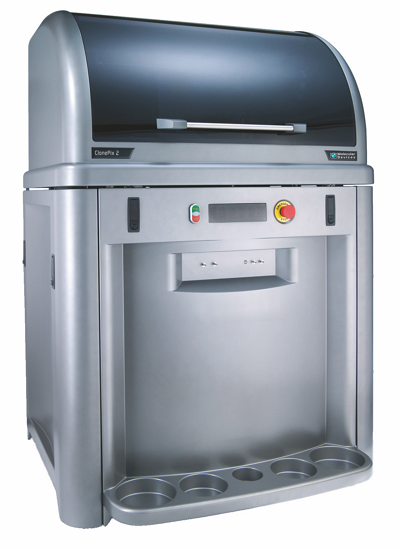
The ClonePix™ 2 Mammalian Colony Picker is a fully automated system for the selection of high-value clones used in antibody discovery and cell line development. Hybridoma, CHO cells, and other cell types are imaged and selected based on user-defined parameters. Plate handling, barcode reading, and picking are all fully integrated. All data, including images, are saved for downstream analysis. The picker increases the probability of finding optimally produced cell lines and significantly reduces time and labor.

Screen more clones in less time
ClonePix 2 picker is 10x faster than labor-intensive limiting dilution and FACS. Our sophisticated software and integrated robotics enables a picking speed of > 10,000 clones per day.

Select cells with desirable attributes
Easily screen and select clones based on protein productivity, antigen-specificity, cell viability, and expression levels of tagged recombinant proteins.

Pick colonies with accuracy
Picking accuracy < 1 mm. Robotic picking reduces risk of colony disturbance. Images of picked clones are stored with data.
Features

Multiple detection methods
White light identifies and measures clone morphology, size and proximity. Fluorescence indicates expression level and/or specificity. Up to five fluorescent filters are available for multiplexing.

Sterility maintenance
A host of sterility features and options including a UV light process for sanitizing the interior of the instrument, as well as pin washing and halogen drying are standard.

Integrated plate storage
Includes two storage stacks for source and destination plates, each with a capacity of 10 plates.

Discrete colony formation
Semi-solid CloneMediaTM encourages single cells to grow into discreet colonies, and allows for ease of plating. The media allows for a higher density of clones to be screened.

Animal-free media and reagents
Chemically defined and animal-free, CloneMedia cell-culture media, is optimized to increase productivity and aid in visualizing secreted antibodies when used with the CloneDetectTM detection agent.

Custom automation options*
The Automated Workflow Engineering Solutions Team can customize the monoclonality system and offer added services such as integrated verification of monoclonality.
*Price, time to deliver, and specifications will vary based on mutually agreed technical requirements. Solution requirements may cause adjustment to standard performance.

Imaging
Software
Dedicated imaging software pre-installed on a high-specification PC, Microsoft Windows 10
White light imaging
Trans-illumination for imaging low contrast colonies such as adherent mono layers or small colonies in suspension
Epi-illumination for imaging colonies as they are collected
Data tracking
Internal barcode reader for source and destination plates enables data tracking for each run
Camera
Integrated 16-bit cooled CCD camera
Imaging speed
6-well microplate: 5 min for 2 wavelengths (standard conditions)
Resolution
Standard: 28 micron
Instrumentation
Containment
Fully enclosed working environment with Class 100-type, HEPA filtration
Source plate type
PetriWell-6 plate, PetriWell-1 plate, Greiner 6-well plate, Nunc 6-well plate, Nunc OmniTray
Destination plate type
PetriWell-96 plate, Costar 96-well plate, Greiner 96-well plate, Nunc 96-well plate, Falcon 96-well plate
Source plate capacity
10 plates
Destination plate capacity
10 plates
Picking head
8 x picking pins – each pin independently controlled
Picking pin size
Diameter of picking pins is application specific – F1: suspension cells, F2: adherent cells
Picking speed
> 200 clones per hour
Wash bath
Ethanol wash bath, automatically refilled
Picking system fluids
5 L sterile water supply, 5L waste bottle
Pin drying
Proprietary halogen pin drying station
Instrument dimensions
1010 mm (width) x 900 mm (depth) x 1490 mm (height)
Instrument weight
350 kg
Compressed Air Specifications
Air
Clean, oil-free with sub-micron filtration
Minimum operating pressure
6 bar (~90psi)
Minimum operating volume
80 L/min
Regulatory Approval
Compliance
CE
Quality
ISO9001:2008 certified
Applications of ClonePix 2 Mammalian Colony Picker
-

Hybridoma Screening
Antibody discovery typically refers to the screening and identification of monoclonal antibodies (mAbs) that target a specific epitope for the diagnosis and treatment of diseases. A common approach to generating monoclonal antibodies involves the fusion of a pre-mitotic cancer cell with a post-mitotic and terminal antibody-expressing B-cell from the spleen. The resulting fused cell is called a hybridoma and has the advantage of producing mAbs while dividing to regenerate itself. Screening hybridomas for binding specificity or productivity can be automated using the ClonePix 2 System.
-

Cell Line Development
Cell line development is a critical step in the process of generating biopharmaceutical molecules, such as monoclonal antibodies. The process often begins with transfecting the host cell type with the DNA encoding the therapeutic protein of interest allowing for random or directed integration of target DNA into the host cell genome. Thousands of clones are screened to isolate the rare high producing cells, a manual and time-consuming process.
-

Monoclonality Assurance
Cell line development and assurance of monoclonality are critical steps in the process of generating biopharmaceutical molecules, such as monoclonal antibodies. A cell line can be established following the isolation of a single viable cell robustly expressing the protein of interest. A key milestone in this process is documenting evidence of clonality. Documentation of clonality is typically image-based, whereby an image of a single cell is produced and included in regulatory filings.
-

Clone Productivity Screening
An important component in identifying high-value clones is determining productivity of single cell-derived colonies. Screening for productivity using traditional approaches is laborious and time-consuming, generally consisting of a multi-step process that involves isolating single cells from limiting dilution followed by assessment of titer using ELISA. The ClonePix 2 System combines single-cell isolation and productivity screening into a single step, resulting in dramatically shorter screening times and increased number of candidates.
-

Cell Surface Expression Screening
Many proteins that express to the surface of cells are targets for the discovery and development of biopharmaceuticals. For instance, G-protein coupled receptors (GPCRs) are the largest class of cell-surface proteins and are targets for almost 40% of existing drugs. Discovery and selection of high-value cell surface clones from a transfected pool of cells can be challenging. The ClonePix 2 System represents an automated method of screening large populations of cells that increases the probability of finding rare high-affinity binder or high producer.
-

Antigen-Specific Screening
Antibody discovery typically refers to the screening and identification of specific antibodies that target an antigen molecule for the diagnosis and treatment of diseases. The specificity of the antibody is based on its ability to bind the epitope, a unique region on the antigen molecule. Therapeutic antibodies are typically monoclonal, single cell-derived and target a unique epitope region on the antigen. The ClonePix 2 System automates screening and rapid detection of antigen-specific clones from a heterogenous population of cells.